(Introduction)
As Brazil’s green mobility market explodes in 2026, many importers are looking toward China—the global leader in EV manufacturing. However, importing electric motorcycles (e-motos) involves complex regulations, logistics, and technical standards. This guide, provided by BODO Electric Vehicle, breaks down everything you need to know to successfully bring high-quality e-motos to the Brazilian market.
1. Understanding Brazil’s Technical Standards (Inmetro & Denatran)
Before shipping a single unit, you must ensure the vehicles comply with Brazilian regulations:
- Inmetro Certification: Essential for components like tires, batteries, and lighting systems.
- CAT (Certificado de Adequação à Legislação de Trânsito): To register vehicles for street use (emplacamento), the model must be homologated by Senatran/Denatran.
- BODO Advantage: We provide all necessary technical documentation and certificates to simplify your local homologation process.
2. Choosing the Right Shipping Method: CBU, SKD, or CKD?
To optimize import taxes and logistics costs in Brazil, you must choose your assembly level wisely:
- CBU (Completely Built Up): Ready to ride. High import taxes, suitable for small sample batches.
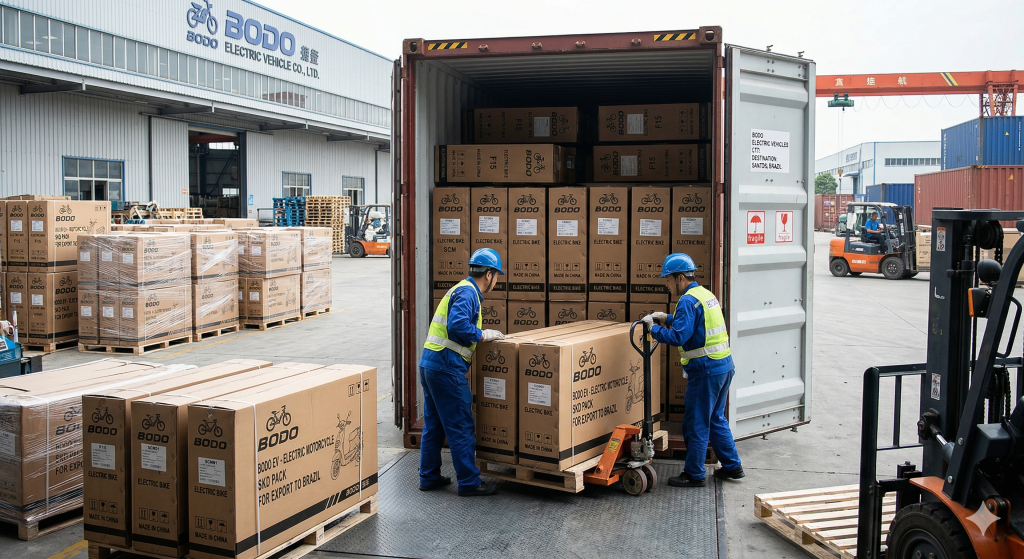
- SKD (Semi-Knocked Down): The motor and battery are separate from the frame. This is the most popular choice for Brazilian importers to balance tax savings and assembly difficulty.
- CKD (Completely Knocked Down): Maximum tax benefits but requires a local assembly line and high technical capacity.
Pro Tip: For most new importers, SKD is the sweet spot for the Brazilian market.
3. Battery Technology for the Brazilian Climate
Brazil’s tropical climate, especially in the North and Northeast, demands robust battery management:
- LFP (Lithium Iron Phosphate): We recommend LFP batteries for Brazil due to their high thermal stability and longer life cycles (up to 2000+ charges).
- Lead-Acid (VRLA): A cost-effective entry-level option, but requires strict maintenance in high-heat areas.
4. Logistics & Customs Clearance (The “Brazil Cost”)
- RADAR: Ensure your company has the RADAR license (SISCOMEX) to perform import operations.
- Ports of Entry: Santos and Paranaguá are the main hubs. Consider the “Manaus Free Trade Zone” if you plan on large-scale local assembly.
- Lead Time: In 2026, expect a 35-45 day sea freight duration from China to Brazil.
5. Why Partner with BODO?
As a specialized manufacturer for the Southeast Asian and South American markets, BODO offers:
- High-Torque Motors: Designed for the hilly terrains often found in Brazilian cities.
- Portuguese Support: We understand your local language and business culture.
- Spare Parts Support: We include a percentage of wear-and-tear parts (tires, brake pads, controllers) in every container.